Style guide · 10 min read
Snake Tattoo Styles Explained: A Visual Field Guide
Twelve real tattoo styles, what visually defines each, and how a snake behaves inside them — from American traditional to ornamental.
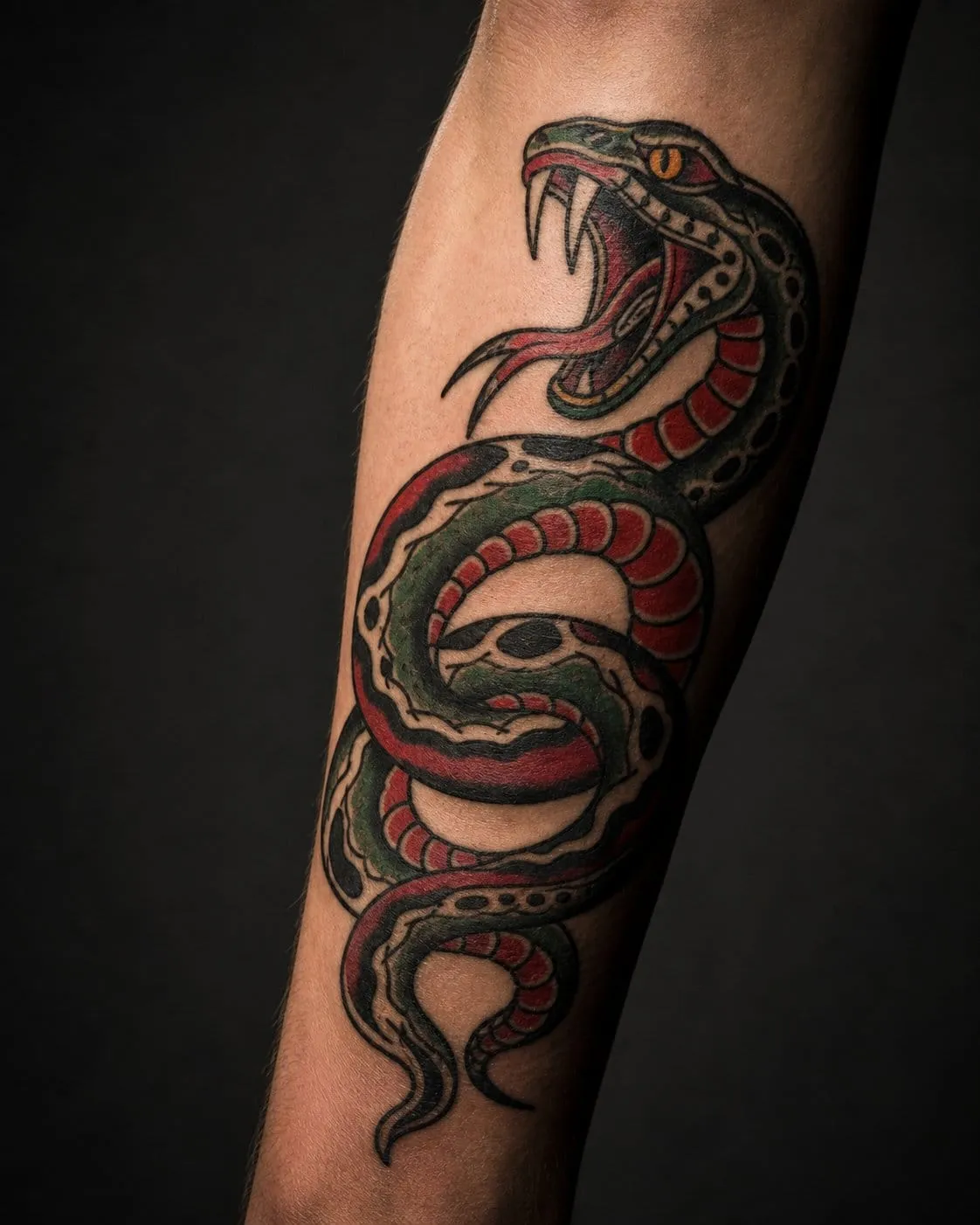
Styles are languages, not filters
A "style" in tattooing is a visual language with its own line weight, palette, shading and history. The same cobra, rendered in traditional versus fine line, is two completely different tattoos. Understanding the languages — even at a tourist level — is the fastest way to stop describing tattoos as "I like the cool ones" and start describing what you actually want.
The bold family: traditional, neo-traditional, blackwork
American traditional is the oldest living Western style: heavy uniform outlines, flat color, iconic silhouettes. It is the most durable way to wear a snake and the most instantly readable. Neo-traditional keeps the bold outline but adds softer shading, richer palettes and decorative florals. Blackwork drops color entirely and commits to solid black and negative space — the most graphic option, and a serious commitment.
The shaded family: black-and-grey, realism, illustrative
Black-and-grey builds form from washes of grey with no color — timeless and dimensional. Realism pushes toward the photographic: species-accurate anatomy, glinting eyes, soft focus. Illustrative keeps a hand-drawn, sketchbook energy with varied line weight and stippling. These three live or die on the artist’s shading; the style is only as good as the hand doing it.
The light family: fine line, minimalist
Fine line uses single or tiny needle groupings for hair-thin, delicate work — intimate and elegant, with a strict size ceiling and a shorter crisp lifespan. Minimalist goes further: one continuous line, almost no detail, maximum restraint. Both are about what is removed, not what is added.
The structured family: geometric, dotwork, ornamental
Geometric rebuilds the snake from facets and polygons — engineered and precise. Dotwork shades everything with thousands of individual points, often into mandala patterns. Ornamental treats the snake as jewelry: symmetric filigree along the body’s centerlines. All three punish imprecision and reward patience.
Japanese: its own category
Japanese tattooing deserves its own box. The hebi is a guardian snake, drawn long and flowing, built into large compositions with waves, wind bars and peonies. It is a tradition with its own rules and its own masters — not a filter you apply, but a school of work you seek out.
How to use this guide
Each style page on this site shows you the visual hallmarks, how snakes behave in that style, what sizes and placements suit it, what to ask an artist, and its honest limits. Read two or three, then go build a concept in the builder — you will know which language you are speaking before you ever email an artist.